25 November 202612 min read
From Naples to Kathmandu to Bochum: Francesco Morgese on Tibetan Studies and a PhD in Italy
A PhD student in Tibetan Studies on studying Tibetan for five years at L'Orientale in Naples, a semester at Rangjung Yeshe Institute, Italy's PhD competition, and a research year in Bochum.

By Francesco MorgesePhD student in Religious Studies (Tibetan Buddhism) at DREST, the Italian Doctoral School of Religious Studies (Buddhism curriculum at L'Orientale, Naples), in cotutelle with Ruhr University Bochum
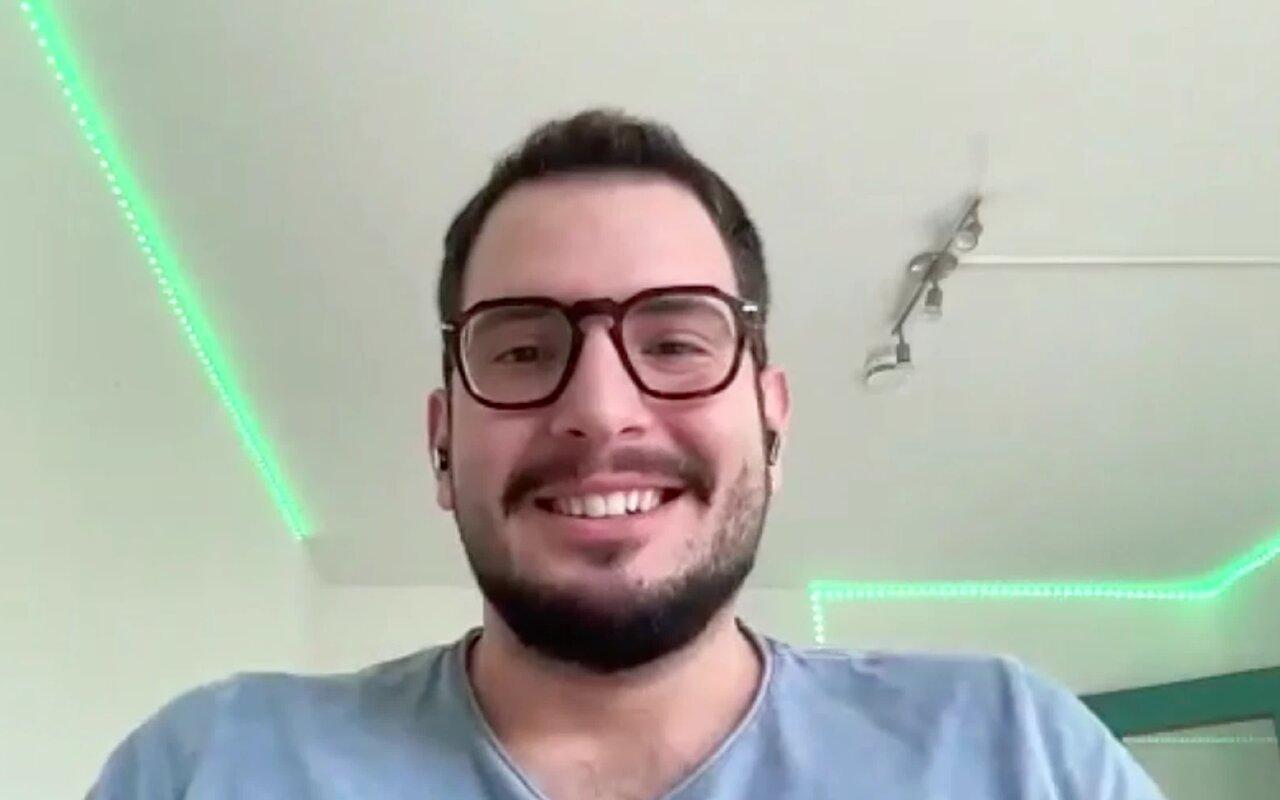
Francesco Morgese is from Naples. He came to Buddhism as a practitioner first, then switched from biology to Tibetan and Sanskrit at L'Orientale, where he did his BA and MA. He spent a summer and a semester at Rangjung Yeshe Institute (RYI) in Kathmandu, which is where he and Mladen met. He is now in the second year of a PhD on a Tibetan master of the early twentieth century, spending a research year at Ruhr University Bochum. We talked about studying in Italy, learning Tibetan in Boudha, getting a PhD place, and what he'd tell someone starting out. The conversation has been lightly edited.
▶️ Watch the full conversation on YouTube (about 67 minutes).
What is your PhD, and what brings you to Bochum?
I did my BA and MA in Tibetan and Buddhist Studies at L'Orientale in Naples, and now I'm in the second year of my PhD. The PhD is in Religious Studies at DREST, the Italian Doctoral School of Religious Studies. It's run by a consortium of Italian universities and research centres: in my case the Buddhism curriculum is offered by L'Orientale in Naples, and the administration is based at the University of Modena and Reggio Emilia. I did my first year in Italy. It's a double degree, a cotutelle, between the University of Modena and Reggio Emilia and Ruhr University Bochum, so I have to spend at least a year here. I arrived a month ago and I'll stay until next summer.
People told me Bochum isn't nice because of the weather, but so far I like it a lot. The university is very international. People come from all over the world, you can study many religions, and you meet people working on very different topics. If you're interested in religion, Buddhism or Asian studies, it's a very good place to be.
Why L'Orientale, and how did you end up in Buddhist Studies?
I started as a Buddhist practitioner. I was studying Buddhist philosophy with FPMT Italy, the Italian branch of the Foundation for the Preservation of the Mahayana Tradition, which is in the Gelug tradition. I got so interested that I thought: to go deeper, I should know Tibetan. At the time I was studying biology. It was during the pandemic, and at a certain point I changed field and started Tibetan and Sanskrit at L'Orientale.
It's a very good place for this, because you can study Asian languages together with philosophy and religion, and you can build your own path by choosing your exams. As far as I know, it's the only university in Italy where you can study Tibetan for five years. Elsewhere you might do one or two exams. And it has a long tradition: Namkhai Norbu taught Tibetan there.
Putting the bureaucracy aside, which is a disaster most of the time, the professors are really nice. There aren't hundreds of students in Tibetan and Sanskrit, so you're in direct contact with the professor, who understands what you need and is flexible.
Are the courses in Italian?
Yes, but it depends on the professor. When there are foreign or visiting students, many professors help them or teach in English. In my Sanskrit course, for example, we sometimes had classes in English because of visiting students. It's the same in the BA and the MA: you can ask, and most professors will find a way.
How is the degree organised?
In the BA you choose two languages. You study your main language for all three years and the second for two. Around that you study literature, philosophy and religions, and the historical context. I also took archaeology, of India and Gandhāra. In the MA you continue the language and literature you started, often with the same professors, so it feels like a continuation of the BA, going deeper.
What might surprise a student from abroad?
Mostly the bureaucracy. There is a welcome centre that helps you plan your exams. Beyond that it depends on the professor. Some are more distant, so you work on your own and wait for feedback. My own experience was very smooth.
Most exams are oral. The thesis is defended: you present your work for 15 or 20 minutes and a committee asks questions. If you study a language, part of the defence is in that language, so I spent five or ten minutes presenting my work in Tibetan.
What does it cost?
L'Orientale is a public university. For Italian students, fees depend on your declared income, and even the highest band is around a thousand euros a year, which is not much compared with many other countries. There are scholarships for students with less money. And the lectures themselves are free to attend; you pay to take exams and earn credits.
What did the BA and MA give you that you still use?
Classical Tibetan, and the basics of colloquial Tibetan. My PhD is about translating texts by Tibetan masters, so I use it every day. Also Sanskrit, and the methods of translating and of research, especially from writing my theses. And the university is how I got to Nepal.
How did the semester at RYI come about?
L'Orientale has a partnership with Rangjung Yeshe Institute, so it was a mobility semester rather than an exchange. I took courses at RYI in philosophy and in classical and colloquial Tibetan, and the credits were recognised in Naples. So I could live in Nepal and study Tibetan without losing time in my degree.
The university gave me some funding, not much, but enough for the travel.
What was it like arriving in Kathmandu from Naples?
Amazing. The context is priceless. Nepali and Tibetan culture are very open and warm-hearted, and living in Boudha I really felt at home. I also got to know the Nyingma tradition and its teachings, which were new to me, and that turned out to be very important for my research now.
Before the semester I did RYI's intensive summer programme in colloquial Tibetan, on my own. For anyone who wants to learn spoken Tibetan, I think the intensive programme is the best way, maybe the only way. In the morning you have grammar, then practice with Tibetan teachers, then another class and more practice. In the afternoon you do homework for the next day, and that goes on for about two months. If you live with a Tibetan family, as we did, you speak Tibetan at breakfast when you're still sleepy, and again at night. It's Tibetan, Tibetan, Tibetan. It's tiring, especially by the end of the week, but I enjoyed it.
What did you take back with you?
RYI's way of teaching. You have to memorise a lot, and that helped me very much. It's not only reasoning and understanding but real effort in memory, which is fundamental for a language. By the end of the semester you can read and translate without a dictionary, which is the main purpose of learning a language, and that's not common at every university.
How did the PhD come about?
It wasn't in my plans. My idea was to work with Dharma centres, translating texts more independently. It was my professor who suggested I try the academic path.
Every year there is a call for DREST, the Italian Doctoral School of Religious Studies, in which several universities work together. It covers all religions, and depending on your curriculum you're based at a different university. For Buddhist Studies there are only one or two places a year, depending on funding, so the competition is high. I prepared a project with the professor who supervised my thesis and applied. In the interview you also show your language: someone spoke Chinese, someone else other languages, and I spoke Tibetan. The preparation at RYI helped a lot there.
I applied to two programmes, my own university's and the national one, and got a place in the national one. So my advice is to try several applications. And look beyond your own country: there are often Tibetan Studies positions at other European universities, which I didn't know at first.
What is your PhD about?
I work on one Tibetan master of the early twentieth century, Dodrupchen Jikmé Tenpé Nyima, a student of Mipham Rinpoche. I'm studying how his thought developed, through texts he wrote at different periods of his life, and how that relates to the Rimé movement and to the boundaries between traditions: which boundaries can be overcome, and how you can see it in the texts. It's fascinating to watch one author's thinking change across his writing.
My BA thesis was on a text by the Fifth Dalai Lama, and I first wanted to continue that in my MA. But in Nepal I realised it would take more time than I had, so I changed topic there. My MA thesis was on the same subject as my PhD, and that worked as groundwork. I think that's a good strategy: if you plan a PhD, make your MA thesis the start of it. You'll have work already done, and a basis for applying for funding.
Why Bochum, and how does a research year abroad work?
Bochum has CERES, the Center for Religious Studies, which I think is really amazing. Professor Carmen Meinert was interested in my project. The department is very international, and I can learn more theory and method in the study of religion, which my BA and MA, focused on language and literature, covered less. I'm here for two semesters.
Because my PhD contract is in Italy, there is extra funding for research abroad, which depends on the country. It's enough to live on: I'm in a university guesthouse with everything provided. It's still less than a PhD salary directly in Germany would be, which is worth thinking about.
How do Italian and German academic life differ?
Here it's very structured. From the start, professors are clear about how much work you have to do. Every week you submit something, at least questions for the next discussion, and you write summaries and short essays. You're forced to prepare, or you'd arrive with nothing to say. It's good practice: you learn to read critically, summarise long papers and ask the right questions.
In Italy, in my experience, teaching is more frontal: the professor lectures and the students mostly listen and then study at home. Here, at least in advanced seminars, it's much more dynamic, with real exchange between students and professors.
Where do you hope the PhD leads?
Honestly, I don't know yet. I'd like to continue this research with a postdoc, because three years isn't enough, and I'll look for funding for it. But nobody tells you what comes after. I think a PhD student has to plan that themselves, and have more than one plan.
Something nobody teaches in a BA or MA is how to find funding and write projects. Someone told me professors today also have to be managers: getting funding, managing it, building programmes with PhD students and postdocs. I'm discovering that year by year. I think universities should teach it to anyone who wants an academic career.
Your advice for someone applying for a PhD in Italy?
Prepare a very good and realistic project. I saw excellent projects that weren't taken, not because they were weak, but because they didn't fit what a professor needed at that moment.
So go and meet the professor you'd like to work with before you apply. You need a supervisor; you don't do a PhD alone. See if there's a good connection, and shape a project that's interesting for them too. A friend of mine came from a quite different field. Before applying, he went to the professor, said what he was interested in and asked what she thought. He got the place. It might sound unfair, but it isn't: people choose to work with someone they know. The project matters, and the person matters too. We're human.
Workshops help with this. Even if you didn't study at that university, you can go, meet the professor, share your ideas and make connections.
And to a student wondering whether to spend a semester in Kathmandu?
Go, and enjoy the surprises. You're never prepared enough; whatever you imagine, it will be different. So go without expectations and with an open mind. That's a bit scary, but it's nice. Of course, prepare the practical things: health, how to prevent problems, where to go and where to eat at first. Then just be very open.
How does being part of a Dharma community sit alongside academic study?
For me it's fundamental. I'm happy that practice came first. The academic approach is necessary, but going deep into the experience through practice gives you much more insight. It gives you energy and motivation to go deeper, and it isn't only something you find interesting; it's part of your life.
FPMT Italy's study programme was a very good basis. The Gelug approach is very structured, which suited me, and it became the groundwork for the academic path. In high school I never imagined Tibetan Buddhism would be part of my life.
You've taught meditation in prison. What is that like?
It has been a great experience for me, and for growing as a person. I volunteer with Liberation Prison Project Italy. The Liberation Prison Project was founded by Venerable Robina Courtin, and in Italy it is connected with FPMT Italy. I found it by joining activities at a Dharma centre.
In prison people really need to take care of the mind, whether they're Christian, Muslim or anything else. It isn't religious or dogmatic: it's talking about how to breathe and how to make a bit more space in the mind, how to step out of anger and negative thinking. Not always, but small changes happen. Some people start writing poetry. Some tell you they were able not to react to provocation. One person in a prison elsewhere wrote that when he cleans his cell he is cleaning his mind, and when he sits quietly he is on retreat. For some people it's really life-changing.
You've practised aikido for many years. Has it shaped how you study?
Yes. My aikido teacher, at Aikido Kodokan Napoli, was, in a Dharma sense, also my spiritual teacher. Before I knew anything about Buddhism, I had the experience of being close to a master, with the difficult moments too: it's not all flowers and roses. I think that's rare today, when there are courses for everything online and you can focus on the material rather than the person. Aikido also took me to Japan and to meditation in a Buddhist temple, so it's through aikido that I discovered Buddhism. What it taught me most is to keep an open mind and see the bigger picture, even when things are difficult.
How do you balance it all?
I don't know, it just happens. Sometimes it's too much. Being in Germany gives me a pause from my busy life in Italy, more time to practise and more time for my research.
With thanks to Francesco. Places mentioned in this interview on the Study Map: L'Orientale, Naples, CERES, Ruhr University Bochum and Rangjung Yeshe Institute. For other ways to learn Tibetan, see Learn Tibetan.